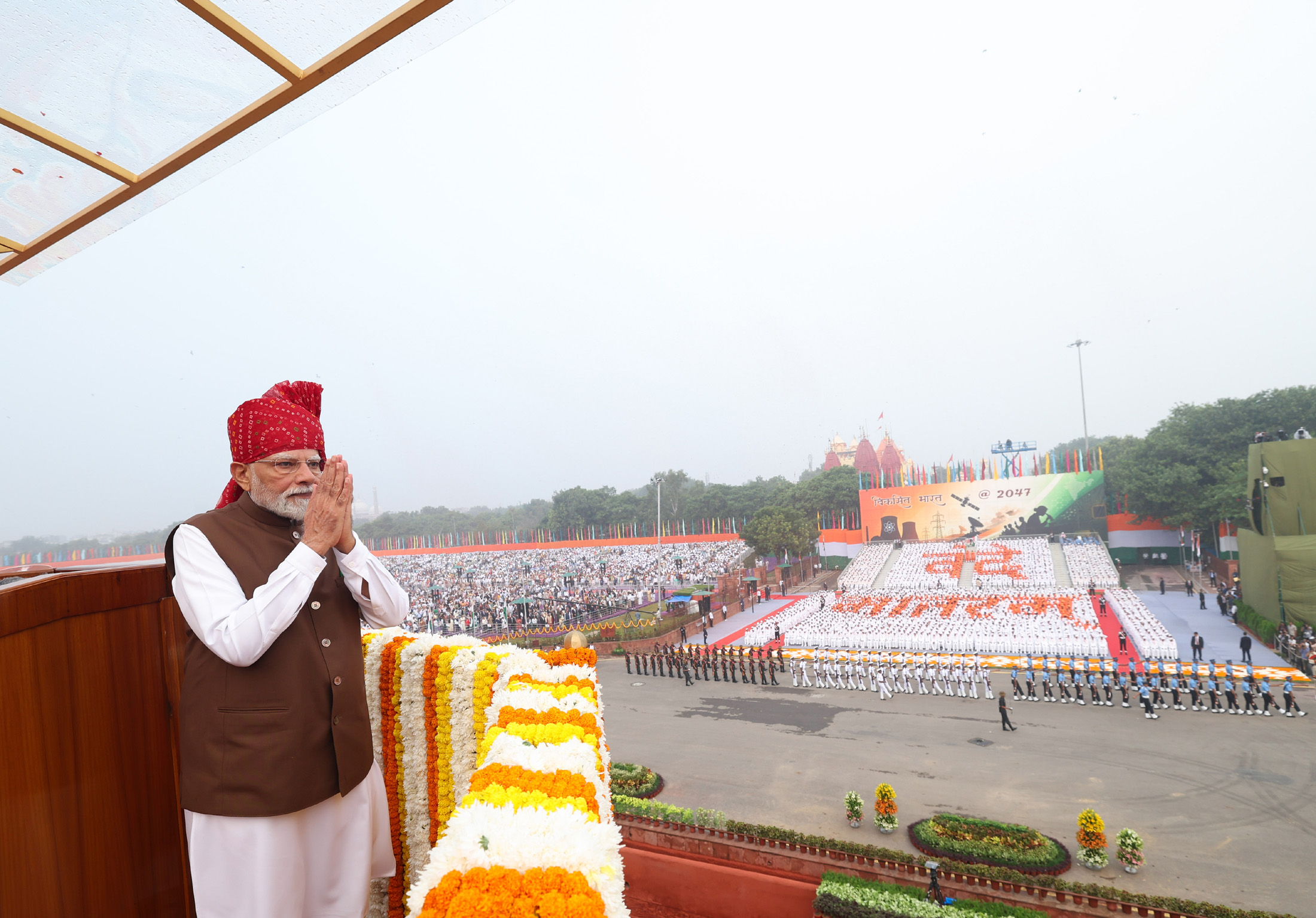
New Delhi, August 15, 2026: Prime Minister Narendra Modi on Saturday addressed the nation from the historic Red Fort on India’s 80th Independence Day, outlining an ambitious roadmap for transforming the country into a developed nation by 2047. The Prime Minister placed self-reliance, technological advancement, energy security, infrastructure development and youth empowerment at the centre of his vision for the next two decades.
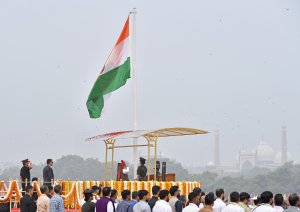

The celebrations carried additional significance this year as India marked the 150th anniversary of Vande Mataram. In a historic first, the national song was rendered as part of the Independence Day ceremony at the Red Fort. Prime Minister Modi linked the spirit of Vande Mataram with India’s national aspirations and its long-term journey towards becoming a developed economy by 2047.
Following the conclusion of his address, Prime Minister Modi shared a warm moment with schoolchildren gathered at the Red Fort. A group of children dressed in white, green and saffron approached him after the speech. Modi stopped to interact with them and shook hands with several students, bringing an informal and emotional close to the national ceremony.
In his address, the Prime Minister said that the vision of Viksit Bharat@2047 represents the aspirations of more than 1.4 billion Indians. He called for collective national efforts to build a self-reliant and economically stronger India, while urging citizens to think beyond short-term objectives and pursue larger national ambitions.
A key feature of the speech was the announcement of ‘Sapta Dhara’, a seven-point reform framework designed to accelerate India’s development journey. The framework focuses on areas including manufacturing, agriculture and food processing, technology and innovation, infrastructure, defence production, the green and blue economy, and India’s global influence and soft power.
Technology and strategic industries featured prominently in the Prime Minister’s vision. He highlighted the importance of semiconductor manufacturing, artificial intelligence and domestic technological capabilities as critical components of India’s future economic competitiveness. The government also announced plans to expand semiconductor manufacturing capacity, while placing greater emphasis on developing indigenous capabilities in strategic sectors.
Youth empowerment was another major focus of the Independence Day address. Prime Minister Modi announced plans to provide artificial intelligence training to one crore young Indians and outlined initiatives aimed at making competitive examination preparation more accessible through free online coaching. The announcements underline the government’s emphasis on preparing India’s young population for an increasingly technology-driven global economy.
Energy security emerged as a central pillar of the Prime Minister’s development strategy. Modi set an ambitious target of taking India’s nuclear power capacity to 100 GW by 2047, while also stressing the expansion of renewable energy. He linked greater domestic energy production with India’s broader objective of reducing strategic vulnerabilities and strengthening long-term economic resilience.
The Prime Minister also highlighted India’s transformation in digital connectivity, digital payments, gas pipeline infrastructure, renewable energy and railway electrification. Modern highways, waterways and expanding transport networks, he said, are strengthening connectivity and creating the infrastructure required to support sustained economic growth.
Manufacturing and self-reliance remained central to the broader message. Modi stressed the importance of increasing domestic production in critical sectors, including essential minerals, energy, semiconductors and defence. The focus reflects India’s efforts to build resilient domestic supply chains and strengthen its position in an increasingly competitive global economic environment.
The Prime Minister’s Independence Day address therefore combined national symbolism with a forward-looking policy agenda. From Vande Mataram and the participation of young Indians to artificial intelligence, nuclear energy, semiconductors, defence manufacturing and global influence, the speech presented a broad vision for India’s transformation over the next two decades.
With 2047 marking the centenary of India’s independence, the Prime Minister’s message from the Red Fort was clear: the country’s next phase of development will depend on technological capability, economic self-reliance, infrastructure, innovation and the active participation of its young population.