FBI Disclosures, Russian Links, and the Full Investigation Behind the Allegations
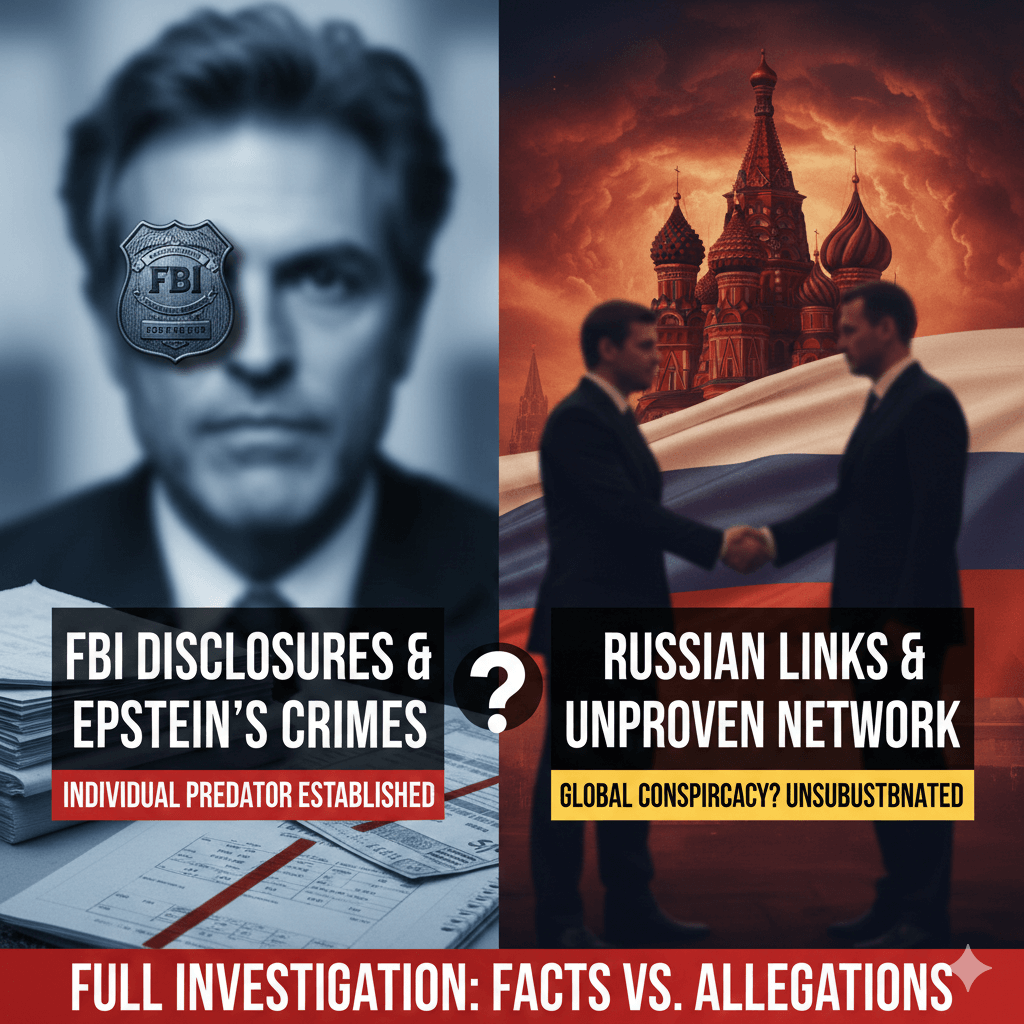
For years, one question has dominated global debate around Jeffrey Epstein—was he merely an individual sexual predator, or the operator of an organized sex-trafficking network catering to powerful and influential figures?
A recent document review by the Federal Bureau of Investigation and the United States Department of Justice adds new layers to this debate—while stopping short of delivering definitive answers.
What the FBI–DOJ Review Found—and What It Didn’t
According to the latest internal reviews, investigators uncovered substantial and credible evidence that Epstein sexually abused underage girls over many years. Financial records, emails, digital data, seized photographs and videos, and consistent victim testimonies firmly establish Epstein’s personal criminal conduct.
However, the most critical conclusion of the review is this:
No conclusive evidence was found proving that Epstein ran an organized sex-trafficking operation on behalf of high-profile individuals.
Federal investigators examined Epstein’s financial transactions, searched his properties in New York, Florida, and the U.S. Virgin Islands, and scrutinized vast amounts of digital material. None of the recovered evidence definitively linked prominent political, academic, financial, or diplomatic figures to prosecutable crimes.
An internal prosecutorial memo stated that while Epstein interacted with powerful individuals, no criminal nexus could be legally established between those contacts and sex-trafficking activities.
“Loaned to Rich Friends”: Allegations and Evidentiary Limits
One victim publicly alleged that Epstein “loaned” her to wealthy and influential friends—a claim that fueled global outrage and speculation.
Yet federal investigators were unable to corroborate this allegation. Other victim testimonies did not reveal a consistent or verifiable pattern of an organized supply network. While some cases suggested the possible involvement of third parties, the lack of admissible evidence prevented federal prosecution, and those leads were referred to local authorities.
A Timeline of Controversy: 2005–2019
The Epstein case dates back to 2005, when the family of a 14-year-old girl filed a complaint in Florida. Investigators later identified at least 35 victims who said Epstein paid them for sexually explicit “massages.”
Years of legal settlements, non-prosecution agreements, and public criticism followed. In 2019, Epstein was arrested again on federal charges—only to be found dead in jail a month later, in what authorities ruled a suicide, deepening public suspicion.
His close associate Ghislaine Maxwell was convicted in 2021 and sentenced to 20 years in prison, confirming that Epstein did not act entirely alone—though the scale of any broader network remains disputed.
Unreviewed Documents and Ongoing Analysis
Investigators have acknowledged that millions of pages of documents remain under review. This leaves open the possibility that new information could emerge.
As of now, official records firmly establish Epstein’s individual crimes, while claims of a high-profile trafficking network remain unproven in court.
The Russia Angle: Attempted Access to the Kremlin?
A more enigmatic dimension of the Epstein case involves his apparent interest in Russian political circles. According to CNN-reported documents, Epstein sought connections reaching the highest levels of Russian power, including President Vladimir Putin.
Contact with Vitaly Churkin
Documents indicate that in 2018, Epstein maintained regular contact in New York with Vitaly Churkin, Russia’s former UN ambassador. Epstein allegedly offered to help Churkin’s son secure employment at a New York wealth-management firm. Churkin’s sudden death in 2017 ended this channel.
Messages Toward Sergey Lavrov
Following Churkin’s death, Epstein sought access to Russian Foreign Minister Sergey Lavrov. In a June 2018 email to Thorbjørn Jagland, then Secretary General of the Council of Europe, Epstein suggested that Putin be advised to have Lavrov speak with him. Jagland replied that he would raise the matter with one of Lavrov’s aides.
Putin Meeting Claims and Unverified Emails
In a 2013 email, Epstein claimed he had declined a meeting request with Putin during a St. Petersburg economic forum, stating that any such meeting would require full privacy and time. There is no independent confirmation that this request ever occurred.
A 2014 email chain suggested preparations for a potential Putin meeting involving Reid Hoffman. Later, Joi Ito publicly apologized for his ties to Epstein and for accepting Epstein-linked funding for MIT Media Lab projects.
Intelligence Agencies and Official Denials
Speculation intensified when Polish Prime Minister Donald Tusk announced that Poland would examine possible links between Epstein and Russian intelligence agencies.
The Kremlin categorically denied these claims. Spokesperson Dmitry Peskov dismissed the theory that Russian intelligence controlled Epstein as baseless and unserious.
High-Profile Contacts and Public Regret
Epstein’s contact list included major global figures. Bill Gates later stated through a spokesperson that meeting Epstein was a serious mistake. However, current FBI–DOJ findings do not connect those meetings to criminal activity.
Conclusion: Facts Established, Questions Unresolved
The Epstein case remains a collision point of power, crime, and accountability.
-
Epstein’s sexual abuse of minors is firmly established.
-
Claims that he ran a trafficking network for powerful individuals remain unproven in court.
-
Russian and international connections raise suspicion, but not legal conclusions.
As document reviews continue, further revelations are possible. For now, the official record portrays Jeffrey Epstein as a serial sexual predator whose personal crimes are undeniable—while the allegations of a global, high-profile trafficking network remain unsubstantiated by admissible evidence.