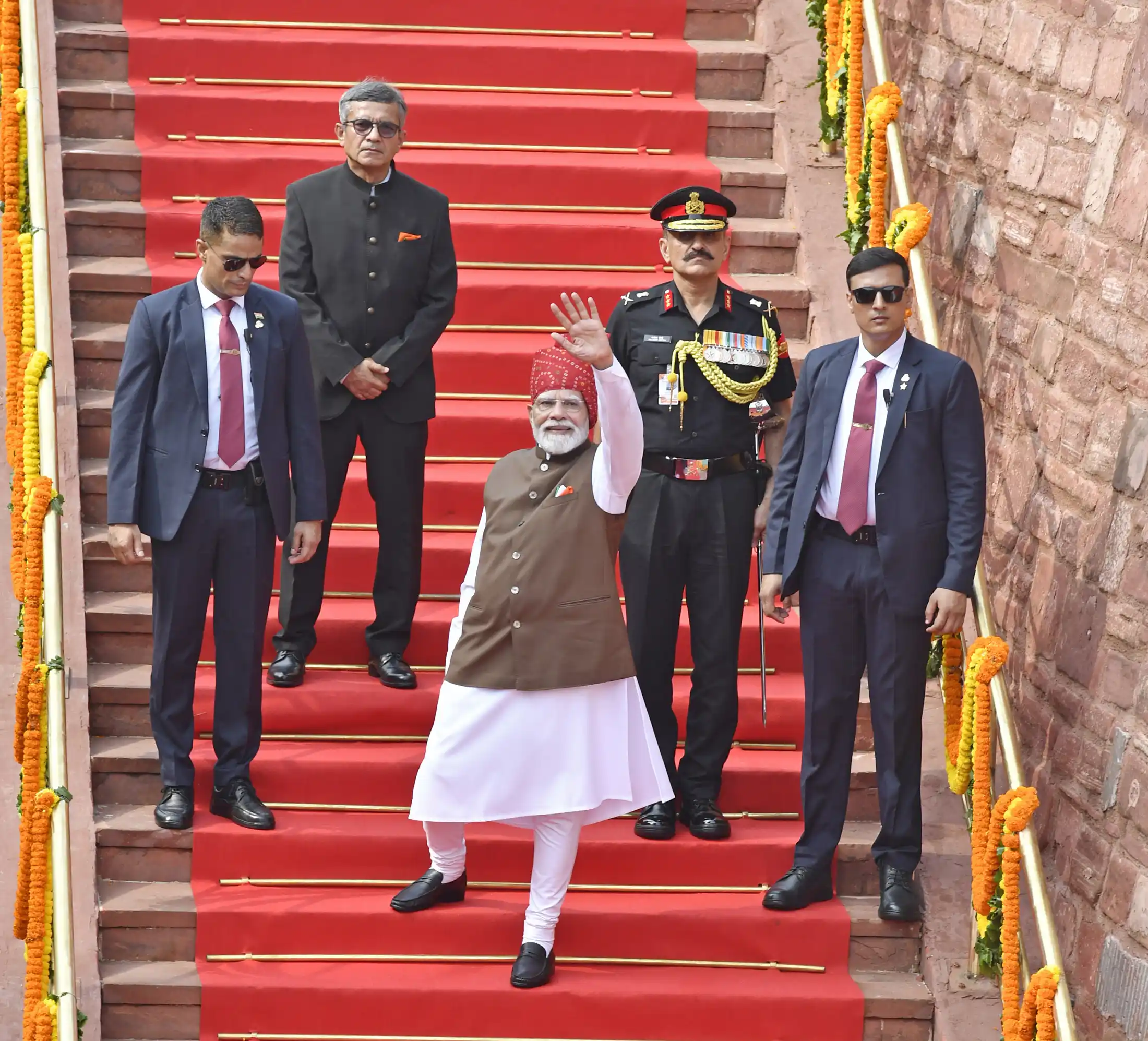
New Delhi, August 15, 2026: Prime Minister Narendra Modi on Saturday delivered his 13th consecutive Independence Day address from the Red Fort, outlining an ambitious roadmap for a developed and self-reliant India by 2047. The address, delivered on the occasion of India’s 80th Independence Day, placed young people, artificial intelligence, technology, energy security, manufacturing, defence and innovation at the centre of the government’s development agenda.
The Prime Minister unfurled the national flag at the Red Fort after paying tribute to Mahatma Gandhi at Rajghat. The flag-hoisting ceremony was followed by a 21-gun salute. In his address, Modi repeatedly highlighted the importance of India’s young population in achieving the goal of Viksit Bharat@2047, describing youth as a key driving force behind the country’s next phase of economic and technological transformation.
AI Training for 10 Million Young Indians
One of the most significant announcements of the address was the government’s plan to provide artificial intelligence skills training to one crore, or 10 million, young Indians over the next year. Modi said the initiative is intended to equip the country’s youth with advanced digital capabilities and enable them to compete and lead in the rapidly evolving global AI economy.
The Prime Minister also announced plans to provide free online coaching for students preparing for competitive examinations. The initiative is aimed at expanding access to educational resources and reducing the financial burden associated with expensive coaching programmes, particularly for students from middle- and lower-income families.
Youth and Start-ups at the Centre of the Development Agenda
Modi placed particular emphasis on entrepreneurship and employment generation, arguing that India’s youth are increasingly moving from being job seekers to job creators. He highlighted the expansion of India’s start-up ecosystem and called for greater support for young entrepreneurs and emerging businesses.
The Prime Minister also stressed the importance of manufacturing, innovation and technology-led growth in creating employment opportunities for the next generation. His broader message was that India’s demographic strength must be converted into economic and technological strength as the country moves towards the 2047 development target.
Seven-Pillar ‘Sapta Dhara’ Framework
A major component of the speech was the articulation of ‘Shakti Ki Sapta Dhara’, a seven-stream framework for India’s next phase of development. The framework covers manufacturing, agriculture and food processing, technology and innovation, infrastructure, defence production, the green and blue economy, and India’s soft power and global influence.
The Prime Minister presented the framework as part of a broader reform-driven approach aimed at strengthening India’s economic capabilities while expanding its global footprint.
Semiconductor Manufacturing Gets Major Push
Technology and strategic manufacturing emerged as important themes in the address. Modi said India would accelerate its semiconductor manufacturing ambitions, with seven to eight new semiconductor plants expected to become operational within the next one to two years. The initiative is aimed at strengthening domestic production of critical technologies and reducing dependence on external supply chains.
The announcement comes amid growing global competition over semiconductor manufacturing, artificial intelligence and advanced technologies. India has increasingly identified electronics and chip manufacturing as strategic sectors for its long-term economic and national-security objectives.
100 GW Nuclear Power Target by 2047
Energy security was another major pillar of the Prime Minister’s address. Modi announced an ambitious target of taking India’s nuclear power generation capacity to 100 GW by 2047. He also highlighted the expansion of solar power and other renewable energy sources as part of the country’s long-term energy strategy.
The Prime Minister also spoke about strengthening domestic exploration and energy resources. Under the ‘Samudra Manthan’ initiative, he announced an allocation of ₹85,000 crore for accelerating offshore exploration, while stressing the need to reduce strategic vulnerabilities in the energy sector.
Sports Talent Hunt for Young Indians
The Prime Minister also announced a nationwide effort to identify and nurture sporting talent at an early age. The initiative is aimed at creating a stronger pipeline of athletes capable of representing India at major international competitions, including the Olympic Games. Reports said the talent identification programme will focus on children between the ages of five and 15.
‘Vande Mataram’ Marks 150 Years
The 2026 Independence Day celebrations also carried special historical significance as India marked 150 years of ‘Vande Mataram’. The national song featured prominently in this year’s celebrations, adding a cultural and historical dimension to the national ceremony.
Modi connected the legacy of Vande Mataram with the country’s aspirations for the future, repeatedly invoking national unity, self-reliance and collective determination as India moves towards the centenary of its independence in 2047.
Focus on a Globally Competitive India
The Prime Minister’s address went beyond traditional Independence Day themes and placed considerable emphasis on India’s position in the global economy. He called on Indian manufacturers and MSMEs to improve quality, scale and competitiveness and use international trade opportunities to expand the global reach of Indian products.
He also highlighted the potential of the green economy, blue economy, creative industries, tourism, technology and India’s cultural influence as areas that could strengthen the country’s global soft power.
A Speech Focused on the Next Generation
The overall message from the Red Fort was strongly centred on India’s next generation. From AI skills and online education to sports, start-ups, semiconductor manufacturing and advanced energy technologies, the Prime Minister presented youth as central to India’s transformation.
With 2047 marking 100 years of India’s independence, the government’s stated objective is to use the coming two decades to accelerate reforms, expand domestic capabilities and position India as a major global economic, technological and strategic power.
Ujala Darpan News Desk
New Delhi | August 15, 2026